Excerpt From History of Vergennes:
On September 19, 1788, Vergennes was incorporated as a city, the third in the new nation and the first in the state. Its name was suggested by Ethan Allen to honor the Comte de Vergennes, French minister of foreign affairs and negotiator of the Treaty of Paris.
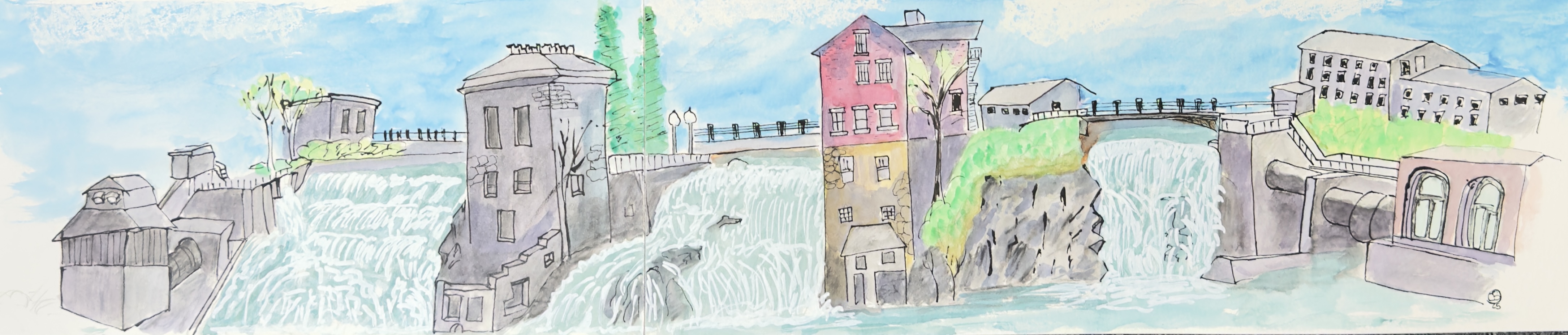
Vergennes grew rapidly in the next decade and diversified its manufacturing and trading activities. Many townspeople worked producing and transporting lumber and potash. A bridge was built across the falls, and by 1789 there were fifty-four households in Vergennes. The Monkton Ironworks Company was established on the falls, and at its height, around 1812, the company had nine forges, blast and air furnaces, a rolling mill, and a wire factory. A tunnel in the west bank of the falls, used to funnel water from the falls to the ironworks, and a towpath along the Otter Creek are some of the archeological remains of the once active industry.
By 1871, carriage, sash and door, hub and spoke, horse nail, furniture, and excelsior factories operated at the falls, as well as a tannery, grist and saw mills and a city waterworks established in 1868. The city waterworks incorporated a Flander’s pump, the Vergennes pump is the only one extant in the country.
In 1893 the Vergennes Electric Company began power generation at the falls, lighting the city streets. And looking forward to the new century, residents in 1897 built a grand new City Hall and Opera House, designed by architects Chappell and Smith of Rutland.
Discover more from Quietly Making Noise
Subscribe to get the latest posts sent to your email.
 Quietly Making Noise